
Did You Choose Freedom, Or Were You Taught To Desire It?
The Freedom We Were Sold — COTH x Ssamssik
Before a product becomes desirable, a story must first be believed.
By Canvas of The Heart
July, 2026
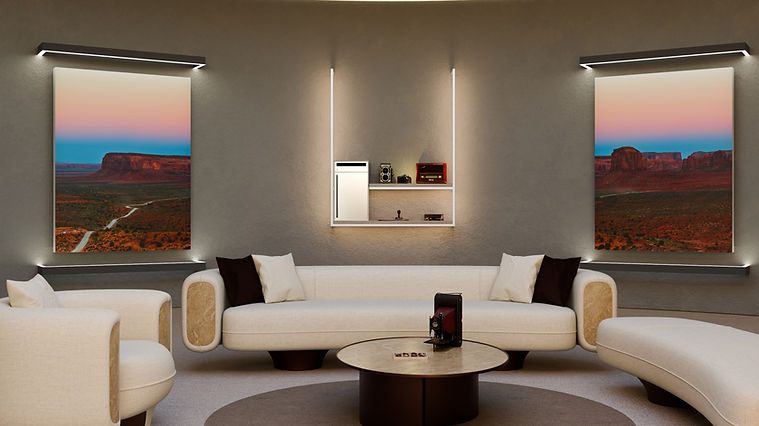
Exhibition view, The Freedom We Were Sold, Canvas of the Heart.
We like to believe our desires belong to us. That the lives we admire and the people we hope to become are shaped entirely by our own choices.
But desire rarely begins in isolation. Often, it is formed quietly through the images we see, repeat, remember, and eventually accept as familiar.
Freedom is one of those images.
For many people, freedom has a recognisable visual language: the open road, the distant horizon, the solitary figure moving through a vast landscape. Even for those who have never visited the American West, these images can feel instantly familiar. They have appeared across films, magazines, advertisements, travel campaigns, and photographs for generations.
Monument Valley is one of the landscapes where this familiarity becomes especially powerful. Long before many people know where it is, they have already seen it. Over time, the place becomes more than geography. It becomes a story — one connected to independence, adventure, and the possibility of becoming someone else.
The landscape itself does not change. The meanings attached to it do.
And it is precisely this familiarity that advertising relies upon.
By the time the Marlboro campaign adopted the imagery of the cowboy and the American West, much of the story was already recognisable. The cowboy already carried ideas of confidence, self-reliance, and independence. The open horizon already suggested escape. Advertising did not need to invent the story; it only needed to step into it.
That is what makes the campaign so compelling. Its power was never only about cigarettes. It was about association: a product placed inside a world people already knew how to desire.
When people looked at those advertisements, what were they really seeing?
A cigarette?
A cowboy?
Or a version of themselves?
The most effective advertisements do not simply sell objects. They offer a promise — of identity, confidence, belonging, or escape. A product becomes persuasive when it begins to feel like an entry point into a life we want.
This question sits at the centre of The Freedom We Were Sold, a virtual exhibition by Canvas of The Heart featuring a fragmented panoramic photograph by Ssamssik.
Divided into eight individual works, the panorama can no longer be consumed all at once. Viewers move through the landscape piece by piece, tracing the distance between the land itself and the meanings attached to it.
The exhibition asks how a landscape becomes an image, how an image becomes a symbol, and how a symbol begins to feel true. It does not tell viewers what to think. Instead, it creates space to notice how ideas take hold.
Yet the question extends far beyond any single campaign. The landscapes may be different, the platforms may be new, but we remain surrounded by images that quietly shape our understanding of who we are, who we might become, and what is worth longing for.
How much of what we believe to be our own desires was placed there by someone else?
We may never stand entirely outside the stories that shape us. But we can learn to recognise them for what they are.
And perhaps that recognition is where choice begins.